The Seam Nobody Owns: What a Capitol Hill Home Inspection Actually Finds
August 13, 2026
August 13, 2026
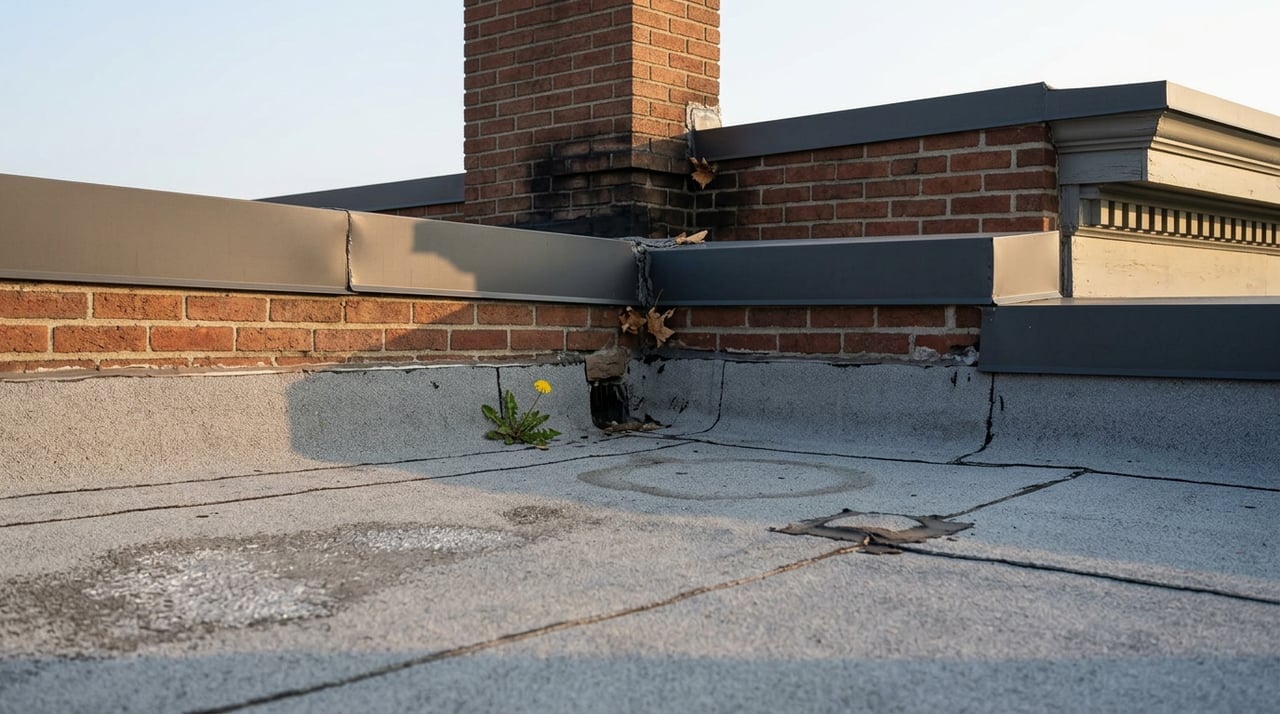
An inspector working a Capitol Hill rowhouse rarely spends his first ten minutes on the things a buyer worries about walking through the front door. He's not in the kitchen checking the water heater. He's up on the roof, crouched at a low brick wall where the house meets its neighbor, running a hand along a seam most owners have never once looked at. That's usually where the report starts.
The finding that shows up again and again in Capitol Hill inspections isn't really about the age of the house. It's about the fact that two rowhouses share a roofline, and the spot where their roofs meet the wall between them belongs to neither owner in any way that gets it properly fixed.
Flat roofs are unusual on houses almost everywhere in the country. On Capitol Hill they're the rule. The neighborhood's row construction, deep narrow lots, shared party walls, produced a housing stock where nearly every roof is flat, a detail more typical of commercial buildings than residential ones outside old dense cities like this one.
That construction style creates a specific weak point. Where a rowhouse's flat roof membrane meets the parapet wall it shares with the house next door, or where one house sits lower than its neighbor and the demising wall rises above the lower roof, the membrane has to tie into masonry that belongs to both properties and neither. Cliff Kornegay of Capitol Hill Home Inspection has spent years flagging the same thing at that junction: missing counterflashing, missing termination bars, the hardware that's supposed to lock a roof membrane to the wall it runs into.
"It is rare to see properly installed termination bars or counterflashing in Capitol Hill roofs."
That's not a materials problem or a workmanship shortcut in the usual sense. It's a coordination problem. A parapet wall shared by two owners requires both to sign off before a roofer can wrap the membrane the way it should be wrapped. Getting that agreement is slow and easy to skip, so installers frequently stop short and leave the seam exposed instead of waiting on a neighbor's approval. Gary Barnhart of GL Barnhart Construction, who has worked on more than a thousand buildings on the Hill since founding his firm in 1997, wrote about this same seam separation at parapet turn-ups in a July 2025 post on his company's blog, describing it as a defect his crews find on nearly every older flat roof they open up.
The parapet seam is the headline finding, but it isn't the only place Capitol Hill's construction produces defects that read as age-related but are actually structural. Many of these rowhouses still have their original roof decking, rough 1x wood planks laid over a century ago, and after decades of expansion and contraction those boards work their nail heads loose, which telegraphs through the membrane above them as small punctures that widen over time. It's a defect built into the original construction method, not evidence of neglect by a recent owner.
There's a second category worth naming separately: structural sensitivity from what's happening next door, not inside the house at all. Kornegay has told local reporters his firm gets calls from property owners near NoMa, where large-scale development has reshaped the ground underneath long blocks of much older construction, and from homeowners whose neighbors are converting adjacent buildings into condos. Moving that much earth near a rowhouse that predates modern foundation standards can create real movement, and an improperly executed underpinning job to fix it can be as risky as the original problem.
None of this means a Capitol Hill rowhouse is a bad bet. It means the report you get back after inspection is more likely to describe a coordination gap than a maintenance failure, and that distinction changes how you should respond to it.
| What the report flags | Why it's actually there | Who resolves it |
|---|---|---|
| Missing counterflashing or termination bar at the parapet | Roof membrane stops at a wall two owners share, and full termination needs both to sign off | Roofer plus a written agreement with the neighbor |
| Seam separation at parapet turn-ups | Original membrane wasn't fully lapped, or has simply outlived its service life | Overlay repair, or a targeted section replacement |
| Small punctures telegraphing through the membrane | Original 1x wood plank decking shrinking and swelling for a century | Identified during a full roof opening, not always visible before close |
| Cracking near a foundation or shared wall | Earth movement from nearby excavation or underpinning work | Structural engineer consult, sometimes monitoring equipment |
None of this friction is new. What's new is how much time a buyer now has to deal with it before closing instead of after.
Over the three months ending May 2026, Capitol Hill homes sold for a median of $925,000, up 2.8 percent from the same period a year earlier, but the pace of those sales slowed noticeably: the average home spent 41 days on the market, up from 33 days the year before, even as more homes changed hands, 220 in May 2026 against 194 the prior May. Movoto's August 2026 numbers tell a similar story from the listing side: a median list price of $741,000, down 7 percent from a year earlier, with homes sitting a median of 55 days before going under contract, about the same pace as August 2025.
Those two data sets measure different things, list price against sold price, so they're not a single trend line. But they point the same direction: this isn't the sprint market where buyers waived inspections to win a bidding war. It's a market slow enough that a buyer can actually schedule a roof specialist or a sewer camera inside a real contingency window, read the report, and negotiate around what it says instead of discovering it after the deed is signed.
That matters most for exactly the kind of finding this neighborhood produces. A missing termination bar at a shared parapet isn't the kind of thing you can fix with a five-minute repair before your walkthrough. It takes a roofer, sometimes a conversation with the neighbor, and time nobody had in a faster market. In 2026, buyers have that time, and sellers whose homes have been sitting past the 40-day mark have more reason to negotiate a credit than to hold firm.
There's one more piece of good news buried in the mechanics here. Historic Preservation Office review on Capitol Hill applies to changes visible from public space, the parts of a house a passerby on the sidewalk can actually see. A flat roof sitting behind a parapet wall generally isn't visible from the street, which means most roof repairs move through permitting faster than window or facade work does. The friction here is neighbor coordination, not the city's review calendar.
If you're under contract on a Capitol Hill rowhouse right now, the practical move is straightforward. Don't let a general home inspection stand in for a roof-specific look at the parapet seams, especially on a house with a neighboring roofline that sits at a different height. Ask whether any recent work touched the shared wall, and whether the neighbor was part of that conversation. If the report comes back with a missing termination bar, treat it as a negotiating point tied to a real repair cost, not a reason to walk. The Capitol Hill Restoration Society maintains contractor listings for historic restoration work in the neighborhood, a useful starting point before you're negotiating on a deadline.
No. It's one of the most common findings on Capitol Hill roofs precisely because of how the neighborhood is built. Treat it as a cost to negotiate, not a red flag about the house itself.
Usually not. Flat roof work behind a parapet wall typically isn't visible from the street, so it doesn't trigger the same review that facade or window changes do. That keeps the repair timeline shorter than buyers often expect.
If you're weighing an offer on a Capitol Hill rowhouse and want to know what a specific block's housing stock is likely to throw at you before you write it, that's exactly the kind of conversation Donald Denton has been having with Hill buyers and sellers for more than four decades. Let's Connect.

Discover a real estate experience defined by trust, expertise, and heartfelt dedication. Donald's lifelong understanding of what “home” truly means guides every client and every decision.