
Why A Capitol Hill Condo's Unit Count Now Decides How It Sells
August 27, 2026
August 27, 2026
Back in March, in my Hill Rag column, I told Hill readers that the days of "keep my condo fees cheap and let the next guy worry" were over, and that anyone shopping a condo here should read the reserves and the owner-occupancy numbers before falling for the kitchen. That column ran five months before the rule that made it a financing question instead of a judgment call.
On August 3, Fannie Mae and Freddie Mac retired the streamlined review process that roughly 40 percent of condo loan files had been running through for years. What replaced it does something no Hill buyer has had to think about before: it sorts buildings by how many front doors they have.
Under Lender Letter LL-2026-03, issued March 18 and mandatory for loan applications dated on or after August 3, the old Limited Review is gone. Freddie Mac killed its Streamlined Review the same day. A large down payment and a strong credit file no longer buy a buyer out of a deep look at the building.
What determines the path is total unit count.
| Your building | What happens on a conventional loan |
|---|---|
| 2 to 4 units, standalone | Waiver of Project Review. Insurance and eligibility still checked, association finances generally not opened up |
| 5 to 10 units, not part of a master association or larger development | Same expanded waiver, per Selling Guide B4-2.1-02 |
| 11 or more units | Full Review. Budget, reserve funding, delinquency rate, master insurance, litigation, special assessments, deferred maintenance |
| Any size that fails one test | Non-warrantable for conventional financing, for every owner in the project, not just the unit under contract |
That last row is the one people misread. Warrantability is not a property condition. It is a project condition. One line in an association budget can take the whole building off the conventional menu, including for the neighbor two floors up who has lived there since 1998 and has done nothing wrong.
Most national coverage of this change was written with a 1970s mid-rise in mind. Capitol Hill's condo stock does not look like that.
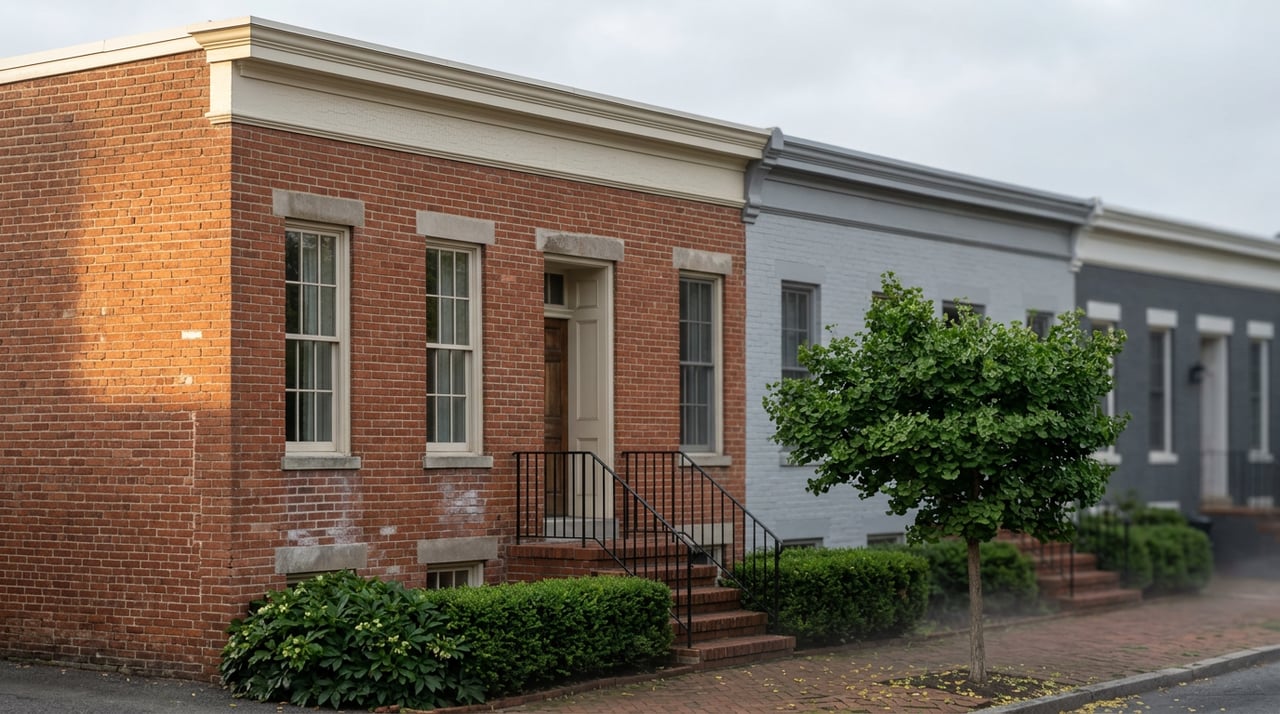
A very large share of what trades here as a condo is a Federal or Victorian rowhouse divided into three or four units, self-managed by owners who are also the board, with a fee that covers water, trash, the master policy and not much else. For fifteen years, those were the buildings lenders squinted at. No management company. No reserve study. Minutes kept in someone's email. Buyers were told the small self-managed building was the riskier buy.
As of this month, those same two-to-four-unit conversions off Eighth Street or up near Lincoln Park sit on the clean side of the line, and the scrutiny has moved to the buildings with elevators and lobbies. The Hill's mid-size and larger projects, the Jenkins Rows and Harrison Houses and Grace Church conversions of the neighborhood, now carry the documentation burden on every single sale. A boutique project like Barracks View, built at ten units, sits exactly on the threshold. Eleven would have been a different building to finance.
There is one more wrinkle worth knowing before anyone assumes small means safe. The waiver is not a blanket pass. The project still has to meet master insurance requirements, and since July 1 the per-unit deductible on that master policy is capped at $50,000. A four-unit conversion whose board raised the deductible a few years ago to hold the premium down can fail on insurance alone while passing on size.
Three dates are already in motion, and the third is the one Hill boards should be talking about at their fall meetings.
Read that third date against the season. Associations adopt next year's budget in the fall. The Hill boards setting their 2027 numbers in October and November are, whether they realize it or not, deciding whether their building is financeable in the spring market. A board that trims the reserve line to hold fees flat for one more year is making a resale decision for every owner in the building.
The scale of the blind spot is documented. In a survey of more than 700 board members, managers and industry professionals, the Community Associations Institute found that 42 percent were unsure whether their community was even eligible for federally backed financing. Among communities already deemed ineligible, 64 percent reported it had hurt home sales or property values.
Here is the part that makes this workable rather than alarming, and it is specific to buying in the District.
Under D.C. Code § 42-1904.11, a condo seller has to furnish the condominium instruments and a resale certificate on or before the tenth business day after the purchaser signs. The buyer then has three business days from receipt to cancel in writing and get the deposit back without deduction. If the package never arrives by that tenth business day, the buyer can cancel before receiving it.
Look at what the statute requires that certificate to contain: the status and amount of reserves, approved capital expenditures not yet reflected in the current operating budget, the most recent financial statement and the current budget, and pending suits or judgments.
That is very close to the same list a Full Review lender is about to request. District law has been handing buyers the lender's homework for years. Almost nobody read it that way, because for a decade the market gave you about ninety seconds to decide anything.
I am not offering legal advice here, and a settlement attorney is the right person for questions about your specific contract. What I am saying is procedural: order the documents the day you ratify, hand them to your lender the same afternoon, and treat that three-day window as a financing review rather than a formality.
Region-wide in July 2026, there were 11,431 active listings on the market according to Bright MLS, up 11 percent year over year and the highest inventory since 2019. Closed sales were flat, new pending sales were down 4.2 percent, and showings slipped 4.7 percent. The median sale price still came in at $650,000, up 1.6 percent from July 2025. Bright MLS chief economist Lisa Sturtevant has been consistent that this year's softness would concentrate in the District rather than the suburban counties.
Sellers do not enjoy reading that. But the resource a condo buyer needs right now is not a discount. It is days. Days to get a project determination from the lender before the appraisal money goes out, days to ask a board for the reserve study, days to find out that the association's 2027 budget draft is already circulating. In 2021, that sequence was impossible. In August 2026 it is simply a normal contract timeline.
Price context matters too. DC condo and co-op medians have sat just below $500,000 since 2024, the most muted appreciation of any property type in the city over the past decade. For a lot of Hill households, the condo is not an investment thesis. It is the thing that lets a longtime owner sell the rowhouse and stay on the same blocks, or lets a first-time buyer get a foothold near Eastern Market. Warrantability decides who can buy that unit, which makes it a neighborhood question as much as a lending one.
Assume the lender is going to ask, and get there first. Pull the current budget and calculate the reserve contribution as a percentage of assessment income rather than looking at the dollar balance. Find out when the last reserve study was done and whether it is inside thirty-six months. Ask the board what the master policy's per-unit deductible is. Check the delinquency rate, because 15 percent or more of units running sixty days behind is its own disqualifier.
A seller who assembles that package before listing is selling to conventional buyers. A seller who discovers a problem at day twenty-five of a contract is renegotiating from the weakest possible position, in a market where the buyer already knows there are other units.
One more thing on the horizon. Bill 26-0495, the Condominium Insurance Amendment Act of 2025, had a public hearing on March 30 and remains before the Committee on Housing. It would raise the deductible that an association can pass through to an individual owner for damage originating in that unit from $5,000 to $25,000, and set minimum HO-6 coverages including $25,000 in loss assessment coverage. It is not law, and it may change. It is worth knowing your loss assessment coverage now rather than after a pipe fails.
None of this makes a Capitol Hill condo a bad buy. It makes the building's paperwork part of the property, in the same way the roof and the party wall are part of the property. If you own one, sell one, or are trying to buy one this fall, Donald Denton has been reading Hill condo documents since long before a lender letter required it. Let's Connect.
Probably not on the review path itself. Standalone projects of ten or fewer units can use the expanded Waiver of Project Review, which does not open the association's finances the way a Full Review does. Insurance requirements still apply, and the project cannot be flagged as unavailable in Fannie Mae's Condo Project Manager.
No. These are Fannie Mae and Freddie Mac standards for conventional loans they purchase. A cash buyer is unaffected by warrantability, which is exactly why buildings that lose it tend to see their buyer pool narrow toward cash and portfolio lending.
The reserve minimum rises to 15 percent of budgeted assessment income on January 4. If your building has more than ten units and the budget falls short, buyers in your project lose conventional financing. That cost lands on whoever sells first.
I would not read it that way. Well-run buildings are still well-run buildings, and the smallest conversions arguably got easier to finance this month. The change simply moved the association's books from optional reading to required reading.






Discover a real estate experience defined by trust, expertise, and heartfelt dedication. Donald's lifelong understanding of what “home” truly means guides every client and every decision.